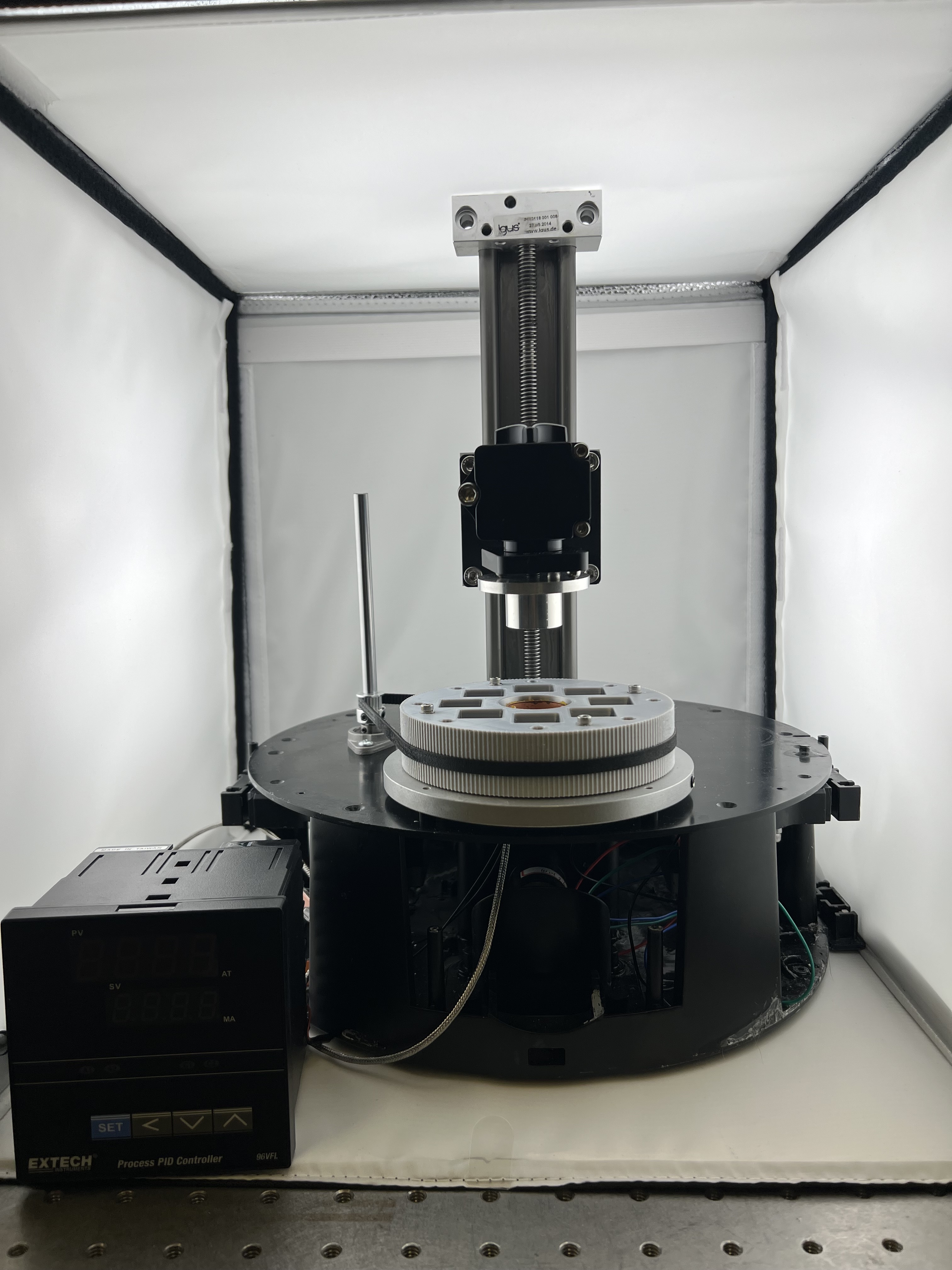
Giving a printer control over material orientation
With Magprint, my colleague Callie Zheng and I wanted to give an SLA 3D printer control over not only a part’s shape but also its microstructural alignment. As part of MIT’s Lemelson–Vest Program, our team designed and built a printer that can apply a parallel magnetic field to a bath of liquid resin in any direction we command.
We built the system out of an old Autodesk Ember printer and a rotating Halbach array. The idea was to align magnetically responsive materials, like ferromagnetic particles and liquid crystal elastomers (LCEs), along each layer while the part was printing—voxel-level control.
A rotating Halbach array
Halbach arrays let us use permanent magnets to design complex magnetic fields. In the magprinter, a Halbach array that produces a straight, uniform field surrounds the SLA resin vat. Rotating the array rotates the field direction. That gives us another variable to work with during a print: the direction in which the material is encouraged to align.
Getting that capability into a printer brings together mechanical design, magnetic-field control, and polymer chemistry. The photo above shows the prototype we built.
Why liquid crystal elastomers?
LCEs are particularly interesting because their directional alignment determines how they respond to a stimulus such as heat. Controlling that alignment allows you to program the way a printed structure bends or twists in response to stimuli like light or heat.
Our materials research explores using a magnetic field to align liquid-crystal monomers while they are still mobile, then using light to fix that orientation into a polymer network. Usually, labs use direct ink writing and other shear-based printing methods, but these techniques couple the toolpath to the resulting printed structure. The aim of magprinter was to fully decouple microstructural alignment from geometry, unlocking a much larger design space.
The printer gives us a way to explore that idea. With the support of Lemelson–Vest, we’re developing both the chemistry and hardware to produce programmable soft actuators.
Connecting materials and machines
Magprint sits at the intersection of the material we want to make and the machine needed to make it. My tomographic VAM work follows a similar thread, bringing printer design together with polymer kinetics and computation.