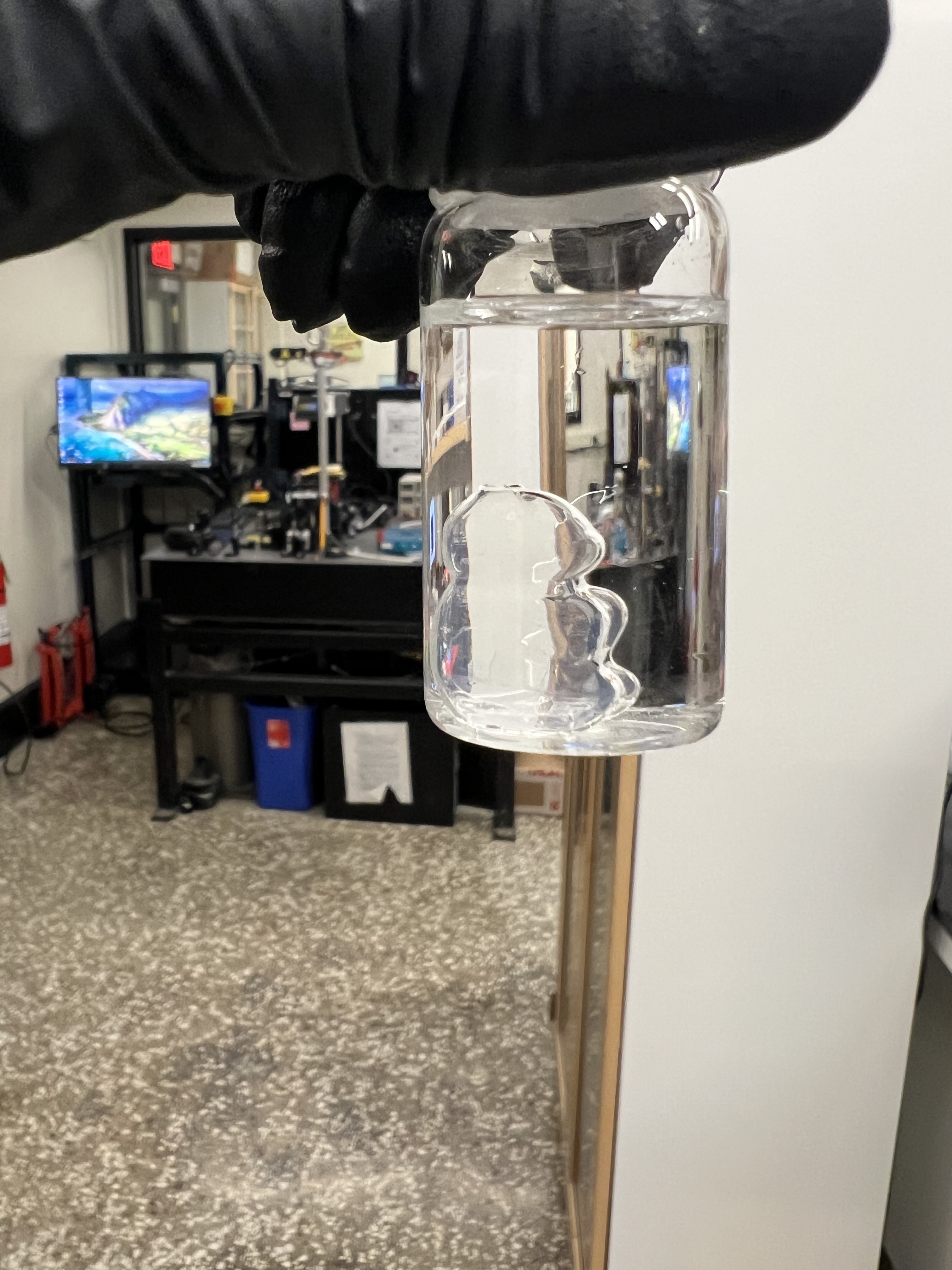
Not just a printer, but a research platform
Tomographic volumetric additive manufacturing (VAM) is a new form of 3D printing that enables extremely rapid fabrication of centimeter-scale parts. Early work at the University of California, Berkeley and Lawrence Livermore National Laboratory was described in 2017, followed by the 2019 paper on tomographic VAM. I started my PhD in 2024 and have been building tools to explore this process ever since.
Under the leadership of Prof. TJ Wallin, I designed, built, and commissioned the first (and second, and third!) tomographic VAM printer at MIT. What made these builds so fun was how many different disciplines had to come together. The machine, the projected light, and the chemistry of the resin all have to work together to get a successful print.
This work connects the hardware of a 3D printer with the chemistry of the material being printed and the computation that determines how to expose it. The printers give us a research platform for exploring those connections through polymers, kinetics, and optimization.
Printing through a volume
VAM is such a fascinating process because the finished part seems to manifest all at once out of nowhere. The magic comes from combining two seemingly disparate ideas: CT scanning and light-hardening plastics.
Ask yourself, what does a gummy bear look like when viewed from the front? What about from the side? The back? How about 47.56 degrees clockwise from the front? It turns out that if you collect enough views, or projections, of a 3D object from various angles, that’s enough to fully reconstruct the geometry.
In a printer, this looks like a rotating vial of resin, a projector, and a set of images that capture each view. By exposing the resin to each image in sequence, we construct a light dose distribution that selectively cures the desired part while leaving the surrounding resin liquid. All at once, a part appears.
The practical challenge is making the projected exposure and the material’s response work together. That relationship is central to my research interests in polymers, kinetics, and optimization.
A sweet demonstration
When I was commissioning our first system, I asked a very talented mechanical engineering undergraduate to pick the model we would use as a test print. Without a moment of hesitation, she selected a gummy bear.
There must be something about gummy bears and VAM because less than a month later, fellow researchers at LLNL published fantastic work using nearly the same geometry, this time in glass.
The video below shows one of the first prints we made at MIT. Delicious… if only the resins weren’t toxic.
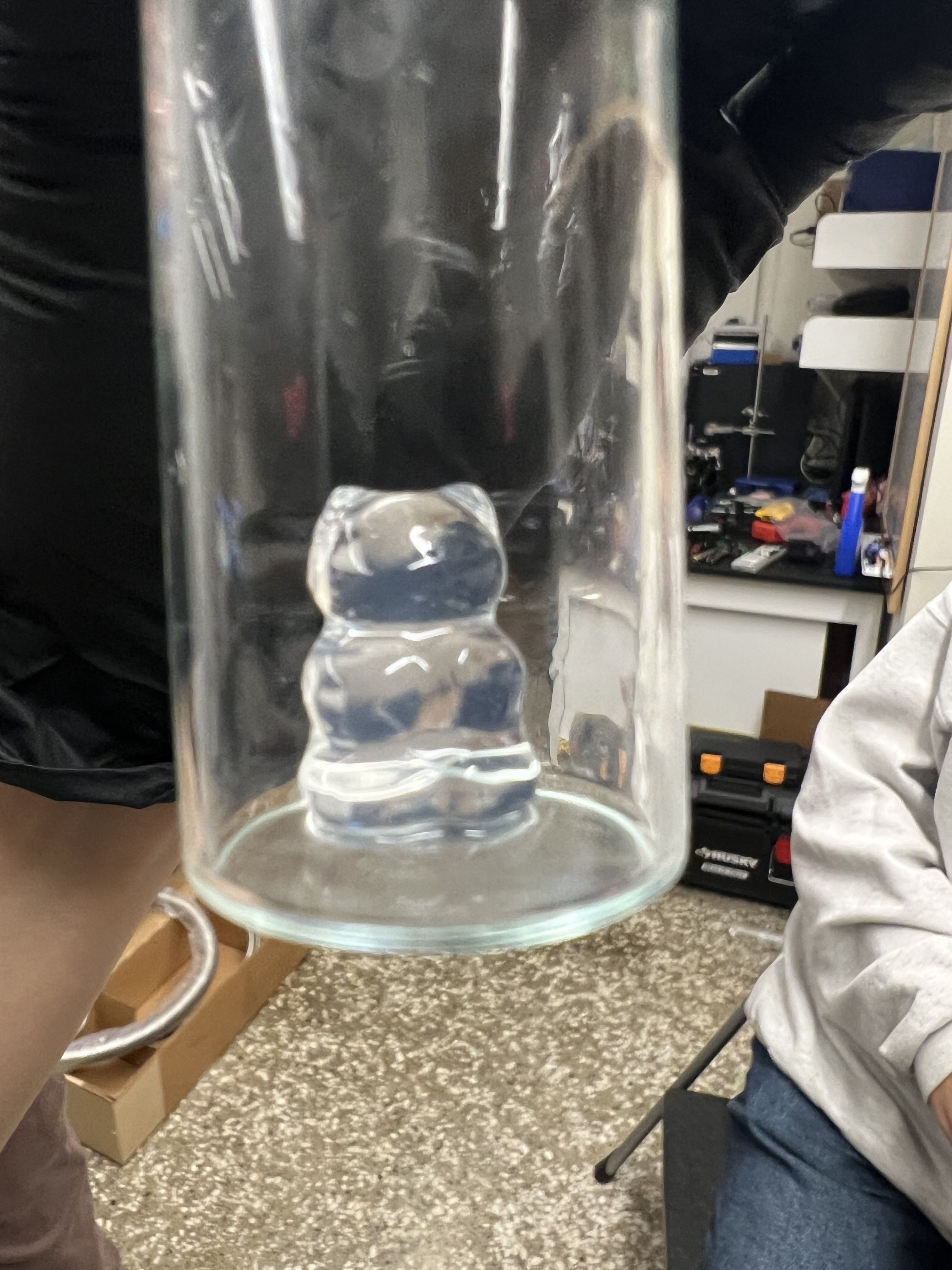
Figure 2. Front view of a demonstration print from our printer. Photo supplied by Hunter Whaples.
Related work
In Magprint, I work on another way to connect material behavior and printer design: controlling magnetic alignment during stereolithography.